
Title: Dodici corde e mezzo (Twelve and a Half Strings)
Instruments: guitar and synthesis sounds diffused in monophony
Duration: 7-10'
Year of composition: 2013-2014
Property, publisher: author
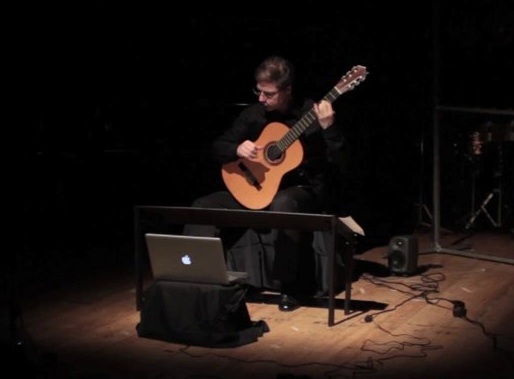
First performance: 10 June,Antidogma Musica Festival, Teatro Vittoria
Instruments: Davide Ficco - guitar, Giuseppe Gavazza: sound direction
Testo italiano in basso
For Festival of Contemporary Music Antidogma, next Tuesday June 10th, at h. 9 p.m., Teatro Vittoria, Turin, first performance of Dodici corde e mezzo, a new composition for guitar and synthesized sounds. The soloist will be Davide Ficco.
The piece propose a personal approach to electroacoustic music.
Normally compositions mixing electronic and acoustic instruments find a balance by amplifying the acoustic instruments: acoustic instruments grow up to electroacoustic dimension.
Personally, in my mix pieces (Experimental Studio SWF Freiburg 1994, Ircam 1996, Gazi Athene 1998, Museo Castello di Rivoli L'Impronta Digitale 1999, Rica-ACROE Grenoble 2001, Cuneo Stagione MNT 2002, Venezia i Virtuosi virtuali 2003, Trio Bio Savigliano 2011 Strange Trio MPG Festival Antidogma Torino 2012, Strange Trio VMG Ecomuseo Salbertrand 2012, Strange Duo MG, Monte Chabriere 2012 and 2013) I often tried to find a balance at the acoustical level, setting down electronic sounds to the instrument instead of pump up instrument to electronic with amplification.
Dodici corde e mezzo is a step of the research I am realizing in PhD at ICA-ACROE, Polytechnic de Grenoble on the subject: "Physical modeling as a tool for musical formalization". Here computer is used to generate the form of the composition: synthesized sounds, diffused by a discrete amplification localized at the same place of the soloist, don't sound like electronics but work as a "Basso continuo" for the performance. At the same time, the score of the guitar is open and gives a lot of freedom to the performer to retrieve the signs and the breath of Baroque through frequent Abbellimenti.
some more information here:
https://listentothisworld.blogspot.com/2014/06/something-new-thursday-june5thth-2014.html
Twelve and a Half Strings II
for guitar and monophonic synthesis sounds
September 2014
Please find below a note related to "Twelve and a Half Strings II" which was written in September 2014. These notes are an accompaniment to version II, which was developed after the premiere performance on June 10, 2014, at Teatro Vittoria, Festival Antidogma Musica. The author has made some changes to improve the quality of the performance after re-listening to the first version of the music and in agreement with dedicatee Davide Ficco. These changes make version II the preferred version of the music for both the composer and performer.
The title "Twelve and a Half Strings" refers to a musical composition that combines six physical guitar strings with six virtual strings created using the Genesis physical model synthesis program. The piece, dedicated to Davide Ficco and premiered at the Festival Antidogma in Turin on June 10th, 2014, is the subject of my current doctorate at ACROE-ICA of the Grenoble Polytechnic.
The extra "half-string" is a crucial element in the composition's structure. It is also a virtual string, but its movement is harmonic and generates frequencies too low to be audible. This gigantic string is anchored at one end, like an open string, and is tuned to 12 octaves below the fundamental F of the chord. Its fundamental frequency is 0.0215 Hz, which means it completes one cycle every 48 seconds. Although it is not an object that creates sound, it becomes audible when it touches the six virtual strings and plucks them during its wide movement. This makes it a sounding object, rather than a "player" object.
"What interests me is what Ezra Pound described in his Treatise on Harmony in 1925. He explained that the percussion of rhythm can enter the harmony as another note would, usually as a deep bass, which gives the main form to the sound.
In my composition, Dodici corde e mezzo, Twelve and a Half Strings, I used a well-tempered deep bass tuned to the fundamental to generate not only the rhythm but also the form of the piece.
To 'flourish' this bass with the live guitar, I used elements of the chaconne form, deduced from the electronically generated part. The performer has a lot of freedom and will play just listening as there is no graphic score for the electronic part. The electronic part is diffused by a small power system in the same place where the guitarist will play unamplified. This is a choice I made for other mixed electroacoustic compositions as well. I prefer to 'bring down' the instruments to a chamber and acoustic sound level instead of 'bringing them up' to the level of electronic sounds by amplifying them.
In my writing, I have used rhetorical formulas for embellishments and a few indications of tempo, attack modes, and dynamics. This type of writing is inspired by the breadth and freedom of execution of Baroque music.
Guidelines for interpretation
The starting point for the interpretation of the piece is the electronic part: a unique audio track that features large areas of silence and thinned-out sounds and determines the duration and form of the performance.
Every interpretative choice will be made by repeatedly listening to this "discontinuous bass" and performing "in tune" to it.
The written part must be performed in its entirety following the alphabetical/numerical order of the sections; any sections or fragments of them may be repeated and even very large pauses may be left between them. The score contains little or no interpretative indications; it is my choice to leave the performer as much freedom as possible for the non-written elements: dynamics, timing, agogics, attack modes, .... In this sense, I have taken baroque writing as a model.
I have used standard flourishes that can be interpreted freely.
I progressively abandon these signs for replacement signs with these meanings:
* = simple flowering (1/2 notes)
** = not very complex flowering (2/4 notes)
*** = well articulated flowering (3/6 notes)
G.G. Grenoble/Bordighera, 17 April-8 September 2014
Testo italiano
Dodici corde e mezzo II
per chitarra e suoni di sintesi in monofonia
Settembre 2014
Le presenti note accompagnano la versione II, scritta dopo l’esecuzione della prima assoluta (10 giugno 2014, Teatro Vittoria, Festival Antidogma Musica) sulla base del riascolto di quella interpretazione e d’accordo con il dedicatario Davide Ficco. Le varianti rispetto alla prima versione sono migliorative, quindi la versione II è da ritenersi, al momento, quella preferita dal compositore e dall’interprete.
Le dodici corde e mezzo del titolo sono le sei corde della chitarra (nella prima a Torino, 10 giugno 2014, Festival Antidogma, quella di Davide Ficco cui il brano è dedicato) che si aggiungono alle sei corde virtuali (intonate sull’accordo, preso in prestito da Messiaen, che polarizza tutta la composizione) modellizzate con il programma di sintesi per modelli fisici Genesis, soggetto del mio attuale dottorato presso l’ACROE-ICA del Politecnico di Grenoble.
La mezza corda in più è la più importante per la forma del brano: è anch’essa un oggetto vibrante virtuale, una corda gigantesca ancorata a un solo estremo (una mezza corda o una corda aperta) accordata 12 ottave sotto il fa fondamentale dell’accordo. Il suo movimento è armonico e genera frequenze troppo basse per essere udibili: la sua fondamentale è una frequenza di 0,0215 Hz, un ciclo che si ripete ogni circa 48 secondi. Questo gran basso fondamentale diventa udibile perché la mezza corda, nel suo largo movimento, sfiora le sei corde virtuali e in alcuni punti le pizzica: non è un oggetto (virtuale) sonoro ma un oggetto suonatore.
Quello che m’interessa è ciò che intorno al 1925 Ezra Pound descriveva, con chiarezza visionaria, nel suo Trattato d’armonia : « Per dirlo in altro modo: la percussione del ritmo può entrare nell'armonia esattamente come farebbe un'altra nota. Di solito entra come Basso, un Basso ancora più profondo, dando la forma principale al suono.» (Ezra Pound, Trattato d'armonia, Passigli, 1988, pag. 39.)
In Dodici corde e mezzo sono sceso ancora più giù, usando un basso profondo ben temperato accordato sulla fondamentale per generare non solo il ritmo ma anche la forma del brano.
Per “fiorire” questo basso ostinato con la chitarra dal vivo ho scelto la forma della ciaccona usando elementi dedotti dalla parte generata elettronicamente. L’interprete ha un amplissimo margine di libertà e suonerà partendo solo dall’ascolto: non esiste partitura grafica della parte elettronica che è diffusa da un sistema di piccola potenza nello stesso punto in cui il chitarrista suonerà non amplificato. Quest’ultima è una scelta - per me importante – già fatta per altre composizioni elettroacustiche miste: nel rispetto degli strumenti invece di “portarli su” al livello dei suoni elettronici amplificandoli, preferisco “portare giù” i suoni elettronici a un livello sonoro cameristico e acustico.
Nella scrittura ho ripreso formule retoriche di abbellimenti strumentali e scarsissime indicazioni di tempo, modi d’attacco e dinamiche; una scrittura essenziale ispirata al respiro e alla libertà esecutiva della musica barocca.
Indicazioni per l’interpretazione
Il punto di partenza per l’interpretazione del brano è la parte elettronica: una traccia audio unica che presenta ampie zone di silenzio e suoni diradati e determina la durata e la forma dell’esecuzione.
Ogni scelta interpretativa sarà fatta partendo dell’ascolto ripetuto di questo “basso discontinuo” e dell’esecuzione “accordata” ad esso.
La parte scritta dovrà essere eseguita interamente seguendo l’ordine alfabetico/numerico delle sezioni; eventuali sezioni o frammenti di esse potranno essere ripetute e si potranno lasciare pause anche molto ampie tra di esse. La partitura riporta scarse o nulle indicazioni interpretative; è mia scelta lasciare all’interprete la massima libertà per gli elementi non scritti: dinamiche, tempi d’esecuzione, agogiche, modi d’attacco, …. In tal senso ho preso a modello la scrittura barocca.
Ho usato segni di fioritura standard che potranno essere interpretati liberamente.
Progressivamente abbandono questi segni per segni sostitutivi che hanno questi significati:
* = fioritura semplice (1/2 note)
** = fioritura poco complessa (2/4 note)
*** = fioritura ben articolata (3/6 note)
G.G. Grenoble/Bordighera, 17 Aprile-8 settembre 2014
For Festival of Contemporary Music Antidogma, next Tuesday June 10th, at h. 9 p.m., Teatro Vittoria, Turin, first performance of Dodici corde e mezzo, a new composition for guitar and synthesized sounds. The soloist will be Davide Ficco.
The piece propose a personal approach to electroacoustic music.
Normally compositions mixing electronic and acoustic instruments find a balance by amplifying the acoustic instruments: acoustic instruments grow up to electroacoustic dimension.
Personally, in my mix pieces (Experimental Studio SWF Freiburg 1994, Ircam 1996, Gazi Athene 1998, Museo Castello di Rivoli L'Impronta Digitale 1999, Rica-ACROE Grenoble 2001, Cuneo Stagione MNT 2002, Venezia i Virtuosi virtuali 2003, Trio Bio Savigliano 2011 Strange Trio MPG Festival Antidogma Torino 2012, Strange Trio VMG Ecomuseo Salbertrand 2012, Strange Duo MG, Monte Chabriere 2012 and 2013) I often tried to find a balance at the acoustical level, setting down electronic sounds to the instrument instead of pump up instrument to electronic with amplification.
Dodici corde e mezzo is a step of the research I am realizing in PhD at ICA-ACROE, Polytechnic de Grenoble on the subject : "Physical modeling as a tool for musical formalisation". Here computer is used to generate the form of the composition: synthesized sounds, diffused by a discrete amplification localized at the same place of soloist, doesn't sound as electronics but work as a "Basso continuo" for the performance. At the same time the score of the guitar is open and give a lot of freedom to performer retrieving the signs and the breath of Baroque through frequent Abbellimenti.
some more informations are here: https://listentothisworld.blogspot.com/2014/06/something-new-thursday-june5thth-2014.html
Title: Twelve and a Half Strings Instruments: guitar and synthesis sounds broadcast in monophony Duration: 7-10' Year of composition: 2013-2014 Ownership, publisher: author First performance: 10 June,Antidogma Musica Festival, Teatro Vittoria Novecembalo: Davide Ficco - guitar Dedication: to Davide Ficco with friendship and fondness