
Title: Knoot
Instruments: flute, bass clarinet and piano
Duration: 5'55''
Year of composition: 1991
Property, publisher: author
First performance: Cappella dei Mercanti, Torino, Het Trio, 1991
Other versions: Nodi, Knaay, Knandr
Listen to a fragment:
Download Here
Listen to the whole composition:
Download Here
read/download the score
CD “Het Trio: Musica nuova in Italia” Happy New Ears, CA 911, 1991
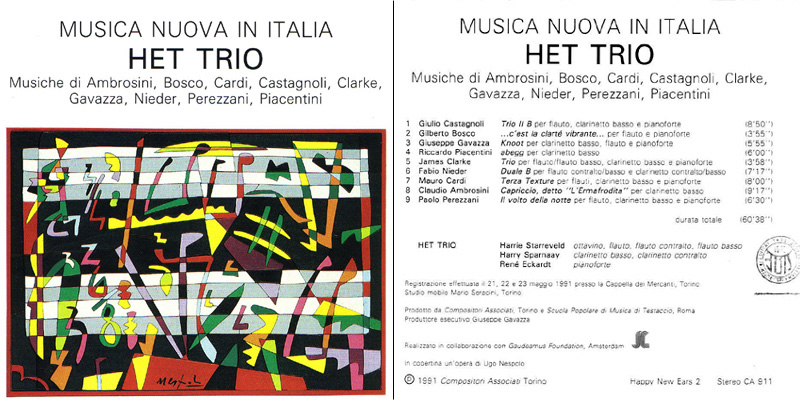
Testo Italiano in basso
An alternative title for Knoot could be "Twenty-one Fragments for 6 Instruments". Where the six instruments are: the bass clarinet in the high register, middle register, and low register, the repeating-same-note flute, the flute in its entirety, and the piano. The fragments are combined, superimposed, and instrumented for three performers. Although it may seem impractical, this title is more clarifying of how the piece is constructed.
Knoot is not a random mosaic but rather a carefully crafted work divided into three sections with an identical geometric formal symmetry. Each section consists of seven subsections, which are the fragments mentioned in the captioned title. These fragments are assigned to different instrumental combinations, including solo, various duo possibilities, and a complete trio.
The piece is composed of several short, self-contained episodes that follow one another, at times overlapping with each other. Only at certain moments, the three instruments come together to create a well-coordinated discourse. The piece is largely based on the regulation of durations and the golden section, a geometric ratio of proportionality that was widely used in Renaissance art and architecture, as well as in music, particularly in the 20th century. This ratio rigidly governs the length ratios between a segment and the two sub-segments that arise from its division.
In Knoot, the segments derived in cascade with the golden ratio express durations. At a higher level they determine the durations of each sub-section-fragment as well as those of the overlaps arising from their interlocking. At a lower level they determine the lengths of the individual sounds, expressed by figures of notes that produce the rhythmic materials used. The golden section generates irrational measures; this leads to the deliberate and desired need to express durations with similarly 'irrational' musical signs; not only irregular rhythmic figures (various possibilities of quatrains, quintinas, septets and the like) but, above all, traditional indications such as the poco or molto accelerando and rallentando, the ritenuto, the a tempo rigoroso, etc., which tend towards the exact execution that, moreover, cannot be achieved. This study on relative durations, i.e. time, needs an underground clock.
The entire piece is marked by a recurring B-flat note, played every three seconds in various instruments, textures, dynamics, and ways of attacking and sustaining the sound. This note sounds different from the rest as it's a heterogeneous sound compared to the remaining eleven sounds of the tempered scale. The note is sometimes evident and isolated between silences or shouted over soft sounds, and sometimes inaudible, pianissimo under loud sounds or camouflaged in homogeneous chords or in rhythmic sequences built on the same note.
The title of the piece, Knoot, is taken from "Knots," a collection of 'poems' by R.D.Laing, a brilliant and controversial scholar of interpersonal psychic relationships. Interestingly, Laing passed away in August 1989 while the composer was writing the first draft of this trio.
G.G. 1990
Testo Italiano
Un altro titolo possibile, più didascalico, per Knoot potrebbe essere:
"Ventuno frammenti per 6 strumenti (clarinetto basso nel registro acuto, nel registro medio, nel registro grave, nota ribattuta di flauto, flauto nella sua totalità e pianoforte) combinati, sovrapposti e strumentati per tre esecutori" forse improponibile ma, certamente, piu chiarificatore di come il brano e costruito.
Knoot è un mosaico, tutt'altro che casuale (un tangram?), diviso in tre sezioni, che ripetono una identica e geometrica simmetria formale; ognuna di esse e costituita da sette sottosezioni (i frammenti del titolo didascalico) affidate a sempre differenti combinazioni strumentali: strumento solista, diverse possibilità di duo, trio completo.
Il brano si presenta quindi come un insieme di brevi episodi autonomi che si susseguono sovrapponendosi in diversa misura; solo in alcuni punti i tre strumenti si ritrovano, si legano, si saldano, per realizzare un discorso coordinato. Quasi tutto nasce da una attenzione concentrata sulle durate e sull'unico rapporto che le regola: la sezione aurea, rapporto geometrico di proporzionalità - particolarmente usato nell'arte e nell'architettura rinascimentali, ma anche in musica, sopratutto nel Novecento- che regola rigidamente i rapporti di lunghezza tra un segmento e i due sottosegmenti che nascono dalla sua divisione.
In Knoot i segmenti derivati in cascata con la proporzione aurea esprimono delle durate. Ad un livello superiore determinano le durate di ogni sottosezione-frammento nonché quelle delle sovrapposizioni che nascono dai loro incastri. Ad un livello inferiore determinano la lunghezza dei singoli suoni, espressa da figure di note che producono i materiali ritmici utilizzati. La sezione aurea genera misure irrazionali; questo porta alla voluta e desiderata necessità di esprimere le durate con segni musicali analogamente "irrazionali"; non solo figure ritmiche irregolari (varie possibilità di quartine, quintine, settimine e simili) ma, soprattutto, indicazioni tradizionali quali il poco o molto accelerando e rallentando, il ritenuto, l'a tempo rigoroso, ecc. che tendono all’esatta esecuzione che, peraltro, non può essere raggiunta. Questo studio sulle durate relative, cioe sul tempo, ha bisogno di un orologio sotterraneo.
Tutto il brano e scandito da un tactus interno, un si bemolle (suono eterogeneo rispetto al resto costruito sui rimanenti undici suoni della scala temperata) che, rigoroso, ogni tre secondi compare in qualche modo, da qualche parte; in strumenti, tessiture, dinamiche, modi d'attacco e di sostegno del suono diversi, talvolta evidente - suono isolato tra silenzi o urlato sopra suoni tenui - talvolta inudibile, pianissimo sotto suoni forti o mimetizzato in accordi omogenei o in sequenze ritmiche costruite sulla stessa nota.
Knoot prende il titolo da "Knots", raccolta di 'poesie' di R.D.Laing, geniale e discusso studioso dei rapporti psichici interpersonali, scomparso nell'agosto del 1989, nei giorni in cui era in atto la prima stesura di questo trio.
G.G. 1990