
Versione italiana a fondo pagina
Title: Play Bach Buch: (Six) pieces on the first Prelude from the first book of Well-Tempered klavier by J.S.Bach.
Instrument: Church organ
Duration: 10'-50'
Year of composition: 1986-2003
Ownership, publisher: author
First performance: not performed
Other indications: notebook of pieces for organ to be played in church or for harpsichord and basso continuo, or for various instruments
PlayBach was the first composition in which I 'exploded' a piece of repertoire. In 1986, I had recently become familiar with the music of American minimalists such as Glass, Reich and Riley, and the keyboard texture of the first prelude from Bach's The Well-Tempered Clavier, Book 1, lent itself well to repetitive writing.
The choice of church organ was dictated by timbral needs and inspired by Bach. I have recently revisited that concept, opting for a performance on the harpsichord with basso continuo, and composing additional pieces for the cycle, which is currently comprised of six pieces. The linear structure of the first piece has been replaced with more articulated development patterns to explore forms consistent with the harmonic structure of Bach's prelude.
As with other explosions, the actual experience of listening to the pieces in question is indispensable in PlayBach, rather than being ancillary to visual and abstract knowledge of the score.
Here is an overview of the cycle, which currently consists of six pieces:
- PlayBach x 8: each bar is repeated eight times.
- PlayBach Arithmetic: the module is an arpeggiated chord of eight semiquavers (half a bar in the original), and the number of repetitions increases by a set amount.
- PlayBach Fibonacci: a one-measure module where the number of repetitions grows according to the Fibonacci series.
- PlayBach Simple Harmonic Tension: the number of repetitions is proportional to the harmonic tension; the more 'tense' the chord, the more it is repeated. To a certain extent, the formal pattern resembles the graphs of Shenkerian analysis.
- PlayBach inverse harmonic tension: the inverse of the previous one, where the number of repetitions is inversely proportional to the harmonic tension of the harmony; the more "strained" the chord, the fewer repetitions.
- PlayBach Harmonic Tension and Form: the number of repetitions is proportional to the harmonic tension and increases progressively as the piece progresses, decreasing more rapidly towards the end.
The Buch can be performed in full or in part. The pieces can be presented in any order, or offered individually at concerts or as interludes between the other pieces on the programme. I plan to add more pieces to the book.
In the harpsichord version, the basso continuo (pedal note) can be performed live or using a pre-recorded track, with acoustic or electronic instruments. A basso continuo track can be requested from the author on CD or another medium.
Performances with other instruments or groups of instruments are possible and should be agreed with the author.
G.G., Venice, September 2003
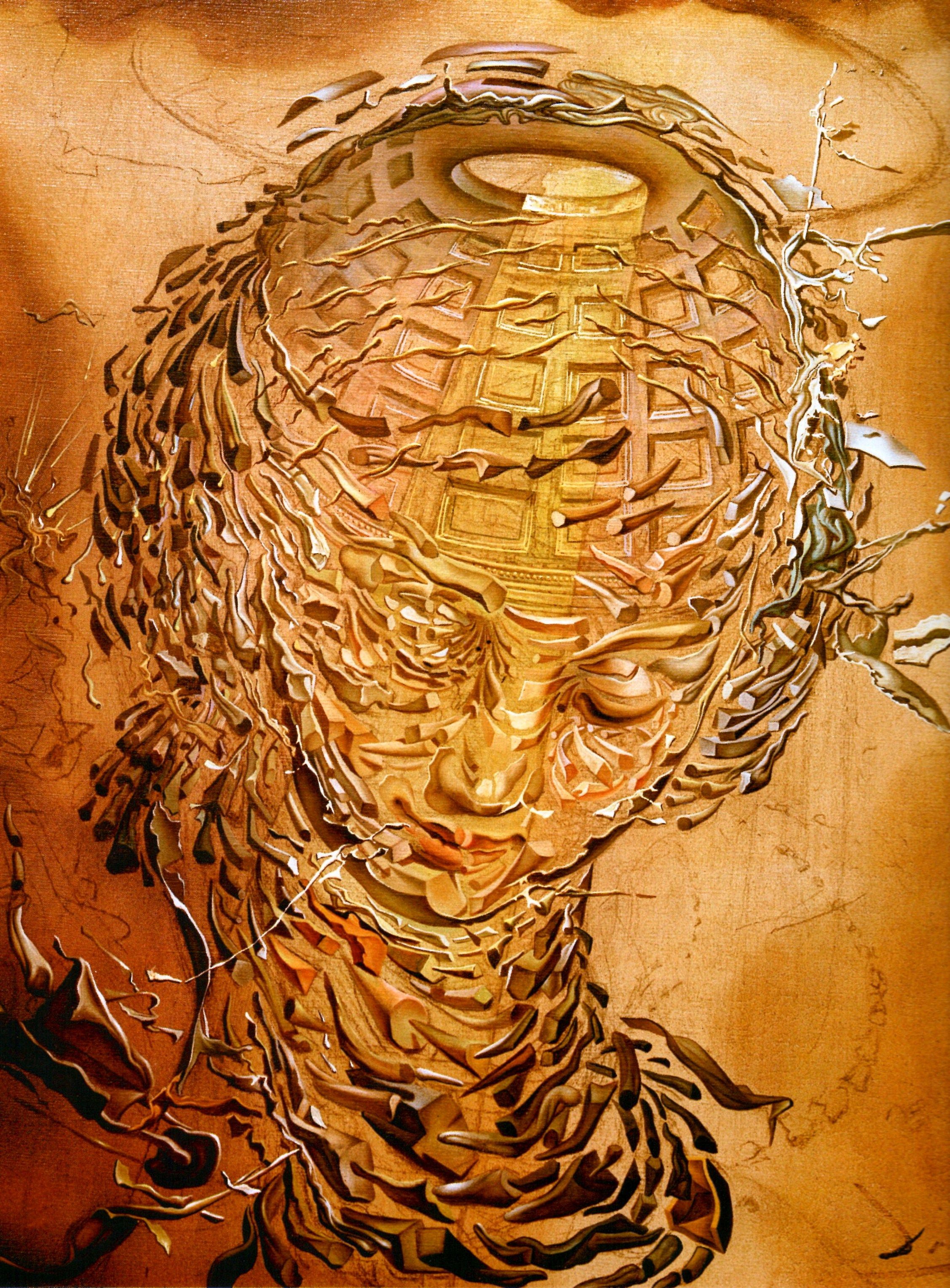
The cycle "explosions" of which this piece is part, was inspired by the painting of Salvator Dalì "Tête Raphaëlesque éclatée"
Titolo: Play Bach Buch: (Sei) pezzi sul primo Preludio dal primo libro del Clavicembalo ben temperato di J. S. Bach.
Organico: Organo da chiesa
Durata: 10’-50’
Anno di composizione: 1986-2003
Proprietà, editore: autore
Prima esecuzione: non eseguito
Altre indicazioni: quaderno di brani per organo da suonarsi in chiesa oppure per clavicembalo e basso continuo, oppure per diversi strumenti
PlayBach è stata la prima composizione in cui ho "esploso" un brano di repertorio. Era il 1986, da poco avevo conosciuto le musiche dei minimalisti americani (Glass, Reich, Riley) e la texture tastieristica del primo Preludio dal Primo libro del Clavicembalo ben temperato di Bach ben si prestava ad una scrittura ripetitiva.
La scelta dell'organo da chiesa fu dettata da esigenze timbriche e suggerita da Bach. Recentemente ho rimesso mano a quell'idea, decidendo di proporre l’esecuzione con clavicembalo e basso continuo e scrivendo altri pezzi del ciclo che è diventato così un Buch, al momento costituito di sei numeri. Alla struttura lineare del primo brano si sostituiscono modelli di sviluppo più articolati per cercare forme diverse ma coerenti con la struttura armonica del Preludio di Bach.
Così come per altre esplosioni - proposte d’analisi percettiva dei brani in oggetto - anche in PlayBach l'esperienza reale dell'ascolto è indispensabile e non accessoria a quella della conoscenza visiva e astratta della partitura.
Ecco un prospetto del ciclo che, al momento, conta sei brani:
- PlayBach x 8 : ogni battuta è ripetuta 8 volte.
- PlayBach aritmetico: il modulo è un accordo arpeggiato di otto semicrome (mezza misura dell'originale) e le ripetizioni crescono seguendo un incremento aritmetico.
- PlayBach Fibonacci: modulo di una misura, il numero di ripetizioni cresce secondo la serie numerica di Fibonacci.
- PlayBach tensione armonica semplice: il numero di ripetizioni è proporzionale alla tensione armonica, più l'accordo è "teso" più è ripetuto. In una certa misura lo schema formale calca i grafici delle analisi shenkeriane.
- PlayBach tensione armonica inversa: è l’inverso del precedente: il numero di ripetizioni è inversamente proporzionale alla tensione armonica dell'armonia, più l'accordo è "teso" meno è ripetuto.
- PlayBach tensione armonica e forma: il numero di ripetizioni è proporzionale alla tensione armonica e, in più, aumenta progressivamente procedendo nel brano per diminuire più rapidamente verso la fine.
Il Buch può essere eseguito per intero o in parte, i brani possono essere presentati in qualunque ordine o proposti singolarmente in concerto, anche come intermezzi ad intercalare gli altri brani in programma. Ho in progetto di aggiungere altri numeri al Buch.
Nella versione per clavicembalo il basso continuo (nota pedale) potrà essere realizzato dal vivo o preregistrato, sia con strumenti acustici che elettronici; un basso continuo su CD o altro supporto potrà essere richiesto all’autore.
Sono possibili esecuzioni con altri strumenti o gruppi di strumenti, da concordare con l’autore.
G.G. Venezia, settembre 2003